
Against the backdrop of AI adoption, the transformation of work formats, and rising employee expectations, companies are revisiting their approaches to hiring, employee development, compensation, and corporate culture. The year 2026 will accelerate the shift of HR from an operational function to a business tool for performance management. This article brings together key global HR trends and their manifestations in Ukraine — from HR process automation and inclusion to local company cases already adapting to the new reality.
Global HR Trends
New approaches to people management are becoming an integral part of everyday practice in companies around the world. Business productivity and the ability to maintain market positions depend on how quickly organizations can respond to change and transform the way they work with people. Below are the key trends currently most widespread in global practice and shaping the direction of the HR function.

The Hunt for Talent
Talent Acquisition is a long-term strategy for sourcing, attracting, and hiring candidates that goes beyond standard recruitment and ensures the formation of a talent pipeline. The market is moving toward skills-based hiring, where practical skills, growth potential, and the ability to quickly acquire new competencies are more important than formal job requirements and diplomas.
Candidate behavior is also changing. Applicants carefully assess management style, process transparency, and corporate culture. 86% of job seekers check company reviews before applying, 78% consider organizational culture when accepting an offer, and 49% decline an offer due to a negative candidate experience.
New Approaches to Job Design
Hybrid and asynchronous work combine physical presence, remote activity, and asynchronous collaboration with a strong focus on outcomes. Building trust, ensuring visibility of remote employees, and maintaining productivity come to the forefront, creating new challenges for team management.
Research shows that 76% of employees prefer hybrid work, and 61% of companies have already implemented permanent remote work policies. At the same time, 74% of HR managers acknowledge insufficient clarity of these policies, while 61% of employees feel disconnected in a hybrid environment. This highlights the importance of new collaboration and team development approaches for effective people management in distributed settings.
Artificial Intelligence and HR Process Automation
Automation and AI in HR are gradually moving from the experimental phase into everyday practice. According to Gartner, the share of organizations where HR leaders use generative AI increased from 19% in 2023 to 61% in early 2025. 73% of HR professionals use AI tools for recruitment, onboarding, and administrative tasks. Moreover, 87% of companies plan to increase investments in HR technologies, and by 2027, 75% of hiring processes will include AI competency assessment in official candidate requirements.
Upskilling and Reskilling
Upskilling and reskilling represent a systematic approach to continuous learning that helps employees update skills and adapt to rapid technological change and evolving labor market demands.
According to the World Economic Forum, 63% of employers will invest in upskilling and reskilling to adapt to technological change, while Gartner predicts that by 2026 up to one-third of vacancies will be filled by internal candidates, making reskilling and capability development a key talent retention tool.
Data and Analytics in HR
People Analytics is the systematic use of data and predictive models to inform people management decisions. It enables organizations to work with clear metrics, forecast attrition, attract talent more effectively, evaluate the impact of development programs, and manage employee experience in real time.
Growing business interest in People Analytics is also reflected in market dynamics: in 2024, the market was valued at approximately USD 8.9 billion, and by 2037 it is projected to grow to USD 41.5 billion. This underscores the strategic role of human data analytics in modern HR and business management.
Focus on Employee Well-being
Well-being is a holistic approach to employees’ physical, mental, and financial health. Companies are moving from one-off benefits to systematic programs that ensure psychological safety, work–life balance, and burnout prevention. Teams with comprehensive well-being programs demonstrate 41% lower turnover and 2.3 times higher engagement.
At the same time, only 38% of employees feel genuine care from their employer, pointing to a gap between expectations and actual practices and emphasizing the importance of effective well-being programs for talent retention.
Inclusion and Diversity (DEI)
Inclusion and diversity ensure equal opportunities and fair treatment for all employees regardless of background, gender, age, or identity.
In 2026, the focus of DEI will shift from declarations and non-discrimination policies to measurable outcomes that directly correlate with ROI and team engagement. This approach must be embedded into overall HR strategies rather than exist separately. The benefits of DEI implementation are evident and confirmed by WorldMetrics research:
-
70% of organizations meet or exceed financial targets;
-
61% of HR leaders report improved business outcomes;
-
companies with diverse leadership are 33% more likely to outperform competitors financially;
-
inclusive organizations are 1.7 times more likely to be innovation leaders.
At the same time, only 26% of employees perceive their workplace as truly inclusive, and 45% believe they need more diversity-related training, highlighting significant potential for further development.
Compensation and Benefits
New standards of compensation and benefits represent a modern reward strategy that goes beyond base salary and includes adapting bonuses to diverse employee needs. In 2025–2026, the focus is on pay transparency and equity, as well as expanding Total Rewards through personalized programs such as health insurance, mental health support, learning opportunities, and additional leave. According to Mercer, the average salary increase budget in 2026 will be around 3.5% of payroll. At the same time, salary benchmarking and pay equity assessment remain top priorities for HR leaders. As a result, compensation directly impacts turnover, competitiveness, and a company’s ability to retain employees in hard-to-fill roles.

HR Trends in Ukraine
Ukrainian companies enter 2026 amid a talent shortage where traditional recruitment and motivation methods no longer deliver results, and mistakes in people management quickly affect business performance.
Labor Market Conditions
The labor market continues to adapt to prolonged war and economic instability. Despite 83% of employers expanding headcount in 2025 and 96% increasing salaries, workforce shortages persist. The most acute shortages are in blue-collar professions — construction workers, electricians, welders, mechanics, truck drivers, and agricultural specialists — reported by 74% of companies. This forces businesses to rethink hiring strategies, offer flexible employment formats, and introduce additional retention incentives.
Salary Expectations
According to HR analysts’ forecasts, the number of vacancies in 2026 may increase by 15–20%, intensifying competition for talent. At the same time, 94% of companies plan salary growth in 2026, including:
-
28% planning increases of 11–15%;
-
23% planning increases of 5–10%;
-
10% planning increases of 16–20%.
However, candidate expectations remain higher than employer offers. According to an OLX survey:
-
31% expect UAH 20,000–30,000;
-
30% expect UAH 30,000–50,000;
-
19% expect UAH 50,000 or more.
The average employer offer is approximately UAH 24,500, while average candidate expectations are UAH 27,300 (Robota.ua), maintaining a gap — especially in blue-collar and other in-demand professions.
Work Organization
Flexible employment formats continue to strengthen their position: hybrid and remote work remain popular, helping companies attract talent not only locally but also from other regions and abroad. Employers offer hourly and project-based work to compensate for staff shortages. Employment flexibility is becoming an effective tool for retention and adaptation to workforce challenges.
Level of HR Process Automation
In response to labor shortages and large candidate pools, HR process automation and digitalization are increasing. Companies implement IT tools for sourcing, ATS systems, and analytical solutions to optimize recruitment, performance evaluation, and workforce planning. Emerging trends include the use of generative AI to create job descriptions and standard HR communications, chatbots for initial screening and candidate interaction, digital onboarding systems, and People Analytics to forecast workforce needs and identify bottlenecks in hiring.
Ukrainian Initiatives
Local companies respond to labor market challenges through systemic changes in their people management approaches. This is evident in projects by nominees of the HR Brand Ukraine Award, where the focus is shifting from individual HR tools to integrated solutions that influence culture, engagement, and team stability.
For example, at PUMB, the “Building Inclusion” project adapts policies, spaces, and digital services to create an environment that reflects diverse employee experiences and needs. The “DNA YASNO” project shapes a shared understanding of corporate principles and supports psychological well-being, increasing interaction and team cohesion. At the same time, companies are improving HR processes: at Carlsberg, the automated onboarding program Welcome Way accelerates newcomer adaptation, while at Raiffeisen Bank, the use of HR analytics enables better understanding of hiring dynamics and data-driven management decisions rather than assumptions.
How to Integrate HR Trends into a Company Strategy in 2026
Ignoring HR trends in 2026 directly increases business risks — this is no longer a matter of image, but of adaptability in a volatile market. To make change effective, trends must be translated into concrete management decisions and metrics:
-
update roles, invest in team reskilling, and use AI to accelerate candidate selection in critical areas;
-
conduct regular salary benchmarking, reduce gaps between market expectations and offers, personalize Total Rewards, and track the impact of well-being programs on turnover;
-
leverage People Analytics to forecast hiring needs, analyze attrition drivers, and assess the effectiveness of HR decisions in order to quickly adjust strategy.

Ultimately, companies that succeed are those that use HR trends as a business development tool. Where people, technology, and culture work in alignment, teams achieve results faster, and organizations adapt more easily and stay on course in an ever-changing market.
 Sun One launches a nomination for companies investing in the development of blue-collar workers
 Sun One Recognized the Best Staff Retention Strategy at the HR Brand Ukraine Awards
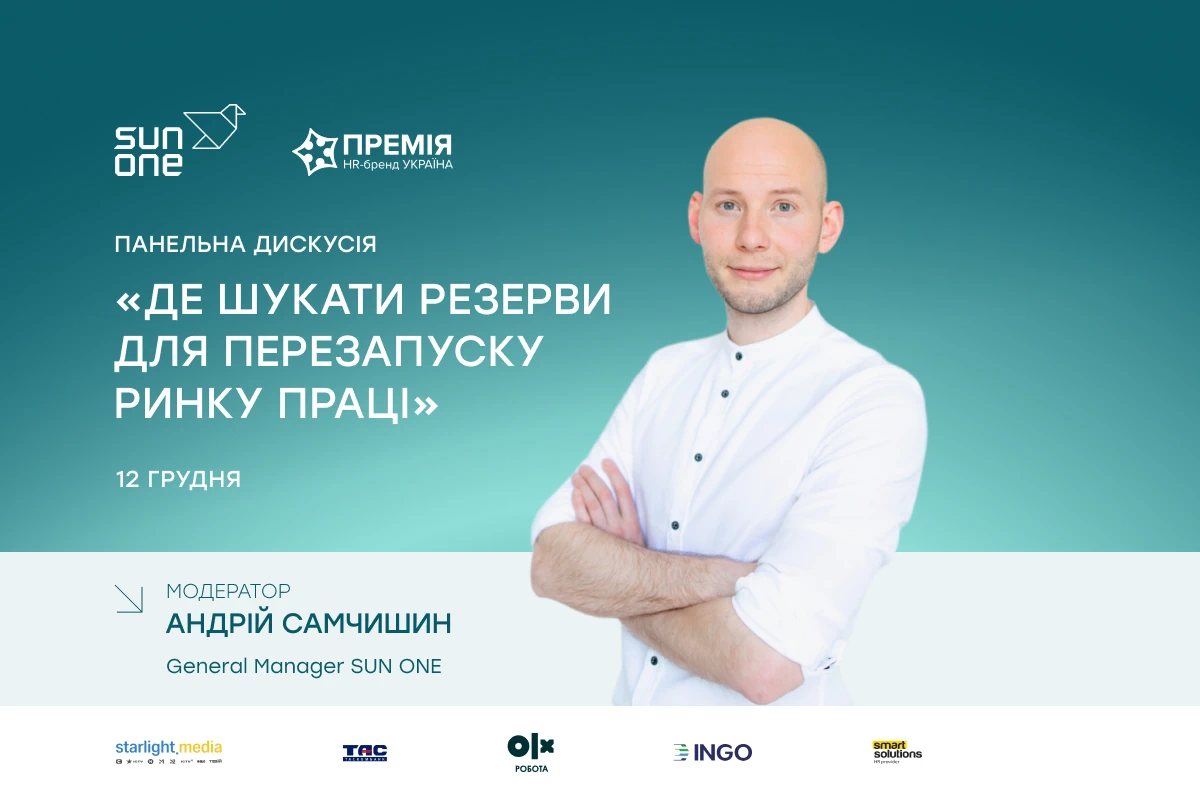 Panel Discussion with Andrii Samchyshyn: Where to Find Resources to Revitalize the Labor Market?